
The Wiley Armory: A Historic Building
By Olivia Kiger
The Robert C. Wiley Armory, originally known as the Waynesburg Armory, was built in 1913 at the corner of Strawberry Street and North Washington Street. From the outside, the red brick structure appears calm and beautiful. Yet behind its stately exterior lies more than a century of wear and tear, marked by two World Wars and decades of rich history in Waynesburg, Pennsylvania.

The Beginning Days
Originally built for Company K of the Pennsylvania National Guard, the armory stands on land donated by the Greene County Board of Commissioners. Its construction was funded in part by a $30,000 appropriation from the Pennsylvania legislature, with the work carried out by W.L. Blair and Sons of Waynesburg.
The front of the building features a two-story wing, with a large drill hall located behind it. Uniquely, the armory was not used solely by the military. The drill hall also served as a space for community events and gatherings. In the early days of the armory, it was recorded to be a site of many trades. There were poultry shows, car shows, and university basketball games. These are just few of many events held at the armory alongside its military use by Company K.

Company K
The Wiley Armory served as the main headquarters for Company K, of the 110th Pennsylvania Infantry. On September 7, 1917, Company K marched south from the armory to the old Waynesburg and Washington Railroad. They all boarded a train to Camp Hancock Georgia and then later set out to France for battle during World War I.
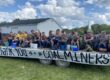
Almost a year later on July 29, 1918, just mere months before the first world war would end, Company K suffered a severe mass casualty. On that day in July, on the grounds of France, 18 men from the company were killed in action or succumbed to their injuries. These men are forever remembered as the Rain Day Boys, a tribute to their sacrifice.

Robert C. Wiley
Robert C. Wiley, a Waynesburg native and alumnus of Waynesburg College, served with distinction in World War II. He enlisted in Company K while attending the college in the late 1920s and steadily rose through the ranks, eventually being appointed Captain of the unit.
After graduating, Wiley worked as a teacher at two local high schools, Nineveh High School and Center Township High School, while continuing his service with the National Guard.
The unit was deployed to Wales in September 1943 to join the 28th Infantry Division during World War II. In late July 1944, they landed in the Omaha Beach region of Normandy.
On August 3, 1944, during combat, Wiley was struck in the cheek by small arms fire. Despite his injury, he refused evacuation and remained on the front lines, risking his life to rally his men and lead them into battle with unwavering courage.
Just days later, on August 9, many of Wiley’s men were killed or wounded in combat. Although he sustained a severe leg wound, Wiley continued to press forward, demonstrating exceptional resilience. On August 13, 1944, he was fatally hit by a sniper’s bullet.
Due to his courageous and fearless efforts in World War II, Robert Calvin Wiley was awarded the Purple Heart, the Distinguished Service Cross, and the French Croix de Guerre with Gilded Star.
The Waynesburg Armory was dedicated and renamed after Robert C. Wiley in 1999.

Wiley Armory Present Day
The Wiley Armory continued to house military personnel for nearly a century. Its last occupant, Company B of the 110th Infantry, remained there until relocating to a new facility in 2010. That same year, Waynesburg University, formerly Waynesburg College, purchased the building. While it was renovated, the university chose to preserve and honor the Wiley name.
Inside Wiley Armory now is Information Technology Services, a wrestling room, and student health services.